

Helping Schools
& Students Thrive
We leverage proven management techniques and education best practices to support school district leaders in raising student outcomes.
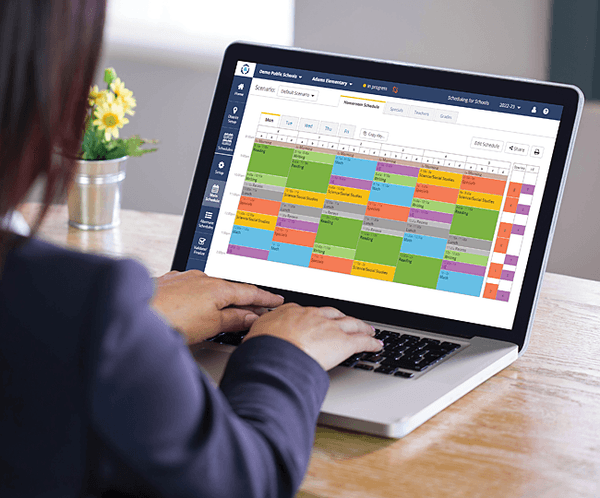
SOFTWARE SOLUTION : DMSchedules School Scheduling Software
What used to take weeks can now be done in hours! Join thousands of educators nationwide who use DMSchedules for their elementary school and special education scheduling.
Schedule a demo
PROFESSIONAL DEVELOPMENT : Fall 2024 Secondary Scheduling Institute
Build your district team’s capacity to design strategic secondary schedules. Open to middle school and high school scheduling teams. Take advantage of 10% off early bird pricing by May 31.
Reserve your spot - register now!
Since 2004, we have partnered with hundreds of school districts across the U.S. to bring about transformational, sustainable improvements in student outcomes and school performance.
- 35
- states
- Hundreds
- of districts
- Thousands
- of school & district leaders
- Millions
- of students supported



How We Help

Accelerated Learning Program
Raise reading and math achievement and increase school attendance and graduation rates while building the leadership capacity of teachers and staff.
Featured Success Story
East Baton Rouge Parish School System (LA)
Third-grade students in East Baton Rouge Parish School System (LA) increased their oral reading fluency by 75% within just 10 weeks.

Consulting Services
Get our expert advice and support to achieve significant and sustainable improvements in your district.
FEATURED SUCCESS STORY
Sioux Falls School District (SD)
Sioux Falls School District (SFSD) sought a new approach to strategic planning that would tightly align vision and mission.
Elementary & Secondary Scheduling Support
Create powerful schedules that raise achievement, improve equity, and save resources.
FEATURED SUCCESS STORY
Elementary Scheduling Made Easy for Minnehaha Academy (MN)
DMSchedules for Elementary Schools scheduling software enabled Minnehaha Academy to create highly-efficient school schedules and successfully implement their priorities.

Professional Development
Enhance your skills and build your capacity with a combination of coursework and coaching in a cohort-based setting.
FEATURED SUCCESS STORY
Boulder Valley School District (CO), Beaverton School District (OR), Tigard-Tualatin School District (OR)
The objective was to learn specific approaches and tools for integrating data into resource allocation decisions.
District Management Council
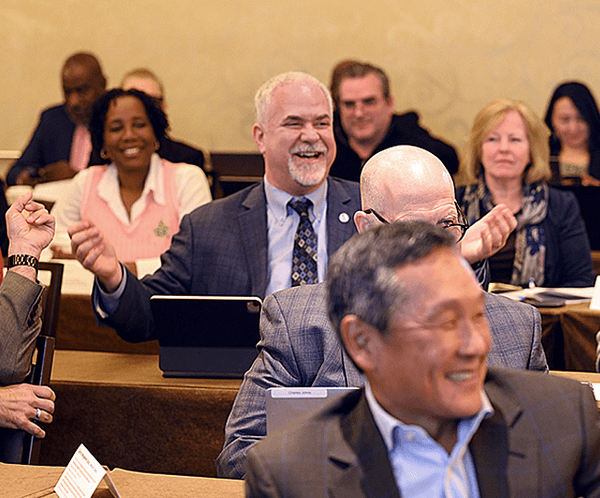
Join our professional learning community for superintendents and district leaders to strengthen your leadership and management capacity to solve complex challenges in school districts.
FEATURED SUCCESS STORY
20th Superintendents’ Strategy Summit Recap
Over 130 district leaders from 50 districts across 18 states gathered for DMGroup’s 20th Summit in New York City to explore strategies to future-proof districts in the face of myriad challenges ahead.
Programs & Events
-
Apr18Get Info
In this roundtable discussion featuring school leaders from New Fairfield Public Schools (CT) and Cambridge Public Schools (MA), we will highlight school stories of the benefits of using the DMSchedules for Special Education Scheduling Software. We will demonstrate how DMSchedules improves student supports, enhances communication and collaboration across schools and districts, and creates equitable learning opportunities for all students.
-
Sep24
PROFESSIONAL DEVELOPMENT
Fall 2024 Secondary Scheduling InstituteGet InfoJoin our in-depth professional development program designed to build the capacity of district and school leaders to design best-in-class secondary schedules. Over four months, participating teams learn by working together to actively understand and apply best practices within the context of their school’s schedule.
-
Oct1
PROFESSIONAL DEVELOPMENT
Fall 2024 Academic-ROI InstituteGet InfoLearn to employ the Academic-ROI methodology to measure what works best for students. Over multiple months, district teams will build the capacity to analyze and assess programs and initiatives to determine what works best for which students and at what cost. This hands-on approach will equip you with knowledge and skills to successfully and sustainability evaluate future district programming.
What Our Partners Say
-

"There isn’t a board meeting that goes by where we aren’t talking about how we are addressing our strategic plan. We are always referring back to our strategic plan. DMGroup’s approach helped us craft a strategic plan that drives our district work."
Dr. Brian Maher
Former Superintendent
Sioux Falls School District (SD) -
“The challenge of turnaround is that a multitude of leadership and management issues must be tackled but taking these on all at once can be overwhelming. DMGroup provided tremendous support and was an important partner.”
Dr. Lawrence Moussoline
Former Superintendent
Downingtown Area School District (PA) -

“We contracted DMGroup to help us with some elementary scheduling. Previously, we used an Excel file to schedule, so finally we now have a very robust program for our elementary schools and our ten elementary principals love it.”
Dr. Pia Burkin
Former Superintendent
New Bedford Public Schools (MA)
